Category: Mobility

  • How Many Sets Per Week to Maximize Muscle Building

    How Many Sets Per Week to Maximize Muscle Building

    How many sets should we have per muscle group each week to make the most progress in the gym? There is significant scientific data suggesting that at least 10 sets per muscle group per week is sufficient to make significant progress with weight training. What we do not currently know is the extent to which increasing this number beyond 10 has on our progress parameters – and requires further scientific investigation. This does not however, mean we should only do 10 sets per muscle group per week.

    If we are truly aiming to maximize the results we see from our training sessions, we can start a training phase at 10 sets per muscle group and add 1 or possibly 2 sets each week until we find what it is we can still recover from. It is easy for us to think that muscle soreness is indicative of recovery but unfortunately this is not the case. Muscle soreness resembles disruption to the muscle cell – once this disruption has passed and has been recovered from, we no longer feel muscle soreness. At this point, our muscles are recovered but full recovery comes from our whole body, not just our muscles.

    Our central nervous system accumulates fatigue every rep of every set. This is why our level of soreness may make us feel like we have recovered but are unable to progress in the gym week to week. Our muscles are actually continuing to make progress with strength and size, we just can’t see it in our performance because our central nervous system is too fatigued for our performance to improve.

    What we should do to combat this as briefly mentioned above, is add 1-2 sets per muscle group per week until we find our maximum recoverable volume (MRV) – in other words, finding the absolute maximum amount of training volume (sets and reps) we can handle in one week, while still being able to be fully recovered by the next time we train that muscle group. Taking a full training program (4-6 weeks) to increase sets each week until we find our MRV can be incredibly useful to prevent ourselves from overtraining and getting injured in the future.

    The intensity of each set we perform heavily influences the amount of fatigue we accumulate throughout a training program. We discussed relative intensity in detail in our “How to Train for Muscle Growth” but will briefly discuss how we can manipulate intensity so we can still recover week to week.

    We want to have at least one set per exercise where we are within 5 reps until failure (5 reps in reserve or RIR) 5 RIR has been shown to be about 90% as effective for muscle building as going all the way until technical failure (0 RIR) but with significantly less fatigue accumulation.

    We can start a new training program with 10 sets per muscle group per week, with our last set of every exercise done within 5 RIR. The next week we can increase from 10 sets to 11 and now get our last 2 sets done within 5 RIR and so on. When calculating sets per muscle group per week it’s very important we first have a good understanding of what muscles are used throughout various movement patterns.

    A quick example is body weight dips: this may seem like it as an exclusive chest exercise but we must remember that sets of dips also count towards our weekly totals for tricep and front deltoid involvement. Even if the chest is the primary mover, we will still factor these in as full tricep, shoulder, AND chest sets in our weekly totals. If this is done incorrectly, it can be very easy to miscalculate our weekly totals and begin overtraining.

    If you want more information on what you can do if you think or know you are overtraining, give our article titled: “What to do When you Stop Making Progress in the Gym ” a read as it goes into detail with various strategies you can take to overcome this.

    If you or anyone you know is interested in taking their training or athletic performance to the next level, give us a call (312-666-7147) or send us an email (info@performancetrainingsystems.com) and one of our many qualified professionals will be eager to help in any way we can!


    References:

    • Helms, 2015
    • McNaughten, 2016
    • Schoenfeld, 2016
    • Tang, 2009
  • What to do When You Stop Making Progress in the Gym

    What to do When You Stop Making Progress in the Gym

    Have you ever been making steady progress in the gym only for you to spend an extended period of time not making any progress? In this article we will discuss what you can do when you hit a plateau with your progress in the gym.

    In previous articles, we have discussed why it is important to train close to failure and to sometimes, even, train all the way to failure. But what happens if we train to failure every set every time we train? It might surprise you to learn that we actually do continue to make progress when training to failure every set; however, after a short time (1-2 weeks) we will be training a specific muscle group before it has had time to fully recover. Without giving our bodies time to dissipate these effects, this will result in us accumulating fatigue from one session to the next. This does not mean we will not be making progress but rather the progress we are making will become masked by our accumulated fatigue.

    For example, on a Barbell Back Squat, let’s say we are able to do 8 reps with 185 lb on the bar and we train every set until complete failure; the next week our muscles will likely be stronger and able to move more weight but we are unable to actually go up in weight on the bar because we are still fatigued from our last session where we did Barbell Back Squat.

    Too much accumulated fatigue is one of the most common reasons for plateauing in the gym. But what can we do to avoid this? And what can we do if we have already accumulated too much fatigue?

    In order to avoid this, take a look back at the past articles titled: “How to Train for Muscle Growth” and “The Importance of Tracking your Progress in the Gym”. These articles outline how to safely and effectively implement progressive overload and how to train close to failure without accumulating too much fatigue.

    If you have already accumulated too much fatigue and want to get back on track, it is advisable to take a “deload” or “active recovery” week. The purpose of this is to allow fatigue to completely dissipate before we begin serious training again while still keeping all of the strength we have gained up to this point. One strategy we can take for a deload is to do the same training we have been doing, using 100% of the weight we were using BUT only doing 50% of the total volume. So if we had 4 sets of 8 on the Barbell Back Squat, to deload we would use the same weight but only do 2 sets instead of 4. This way we continue to hold the strength we have gained but do a small amount of total volume, so we aren’t accumulating too much fatigue.

    Another strategy you can take to dissipate fatigue is to begin a new training program. During the first week of a training program with new exercises, we never exactly know what our working weight is right away. So we can start with the weight low and work up from there. For example, if you have 4 sets of 8 reps, start with the weight low, and work up from there to the point where only the last one or two sets are at our working intensity (~5 reps in reserve).

    [Sample progression for Barbell Back Squat]

    • Set 1: 115lb x 8
    • Set 2: 135lb x 8
    • Set 3: 165lb x 8
    • Set 4: 185lb x 8

    This will allow us to learn the correct technique of the exercises we will be doing next, while still using the muscles we want to keep our strength with so that we do not lose any of it. You can see how this strategy is similar to the deload week but this way, we can use our “deload” time to practice the technique for future exercises.

    If you or anyone you know is interested in taking their training more seriously and taking all of the guesswork out of your training decisions, give us a call (312-666-7147) or send us an email (info@performancetrainingsystems.com) and one of our many qualified professionals will be happy to help!

    References

    • Helms, 2015
    • Schoenfeld, 2016
  • Why You Should Track Performance While Training

    Why You Should Track Performance While Training

    Do you want to make sure you are making progress in the gym from week to week? Tracking your performance is one of the most important factors regarding our previous article: “How to Train for Muscle Growth” where we discussed the proper implementation of progressive overload.

    For a quick recap, progressive overload refers to us progressing the difficulty of our training from one week to the next to continue to challenge our bodies. Without a continuous increase in difficulty, there is no need for our bodies to adapt any further. This increase in difficulty can come in many forms, from increasing the weight, to reducing rest periods, to changing our repetition range, the list goes on. The bottom line is that if we do not continue to challenge ourselves, we will not continue to make progress.

    With progressive overload in mind, we want to make sure we are not pushing ourselves too hard from week to week. Pushing too hard can cause us to become overtrained and unable to recover before the next time we train that muscle group.  You could actually be continuing to make strength improvements when overtrained but are unable to increase weight room performance week to week because our fatigue is masking our progress.

    Being overtrained also puts us at a significantly higher risk for injuries while training. When the muscles we are trying to train are fatigued, we begin to incorporate other muscles into our movements in what we call “compensation patterns”. For example, if our legs are overtrained heading into a leg day and we start with deadlifts; due to fatigue, our legs will be unable to produce the same force they were last week so when we try to lift the same weight, we could be using more of our low back muscles than usual which increases our risk for back injuries.

    The two most important aspects of this article are that we need to increase the difficulty of our training from week to week and we need to make sure we are not overtraining ourselves. The implementation of these two aspects becomes significantly easier when we begin recording the performance of our training.

    Without recording our performance, it can be very difficult to remember what we did each set the previous week. If we can’t remember what we did the week before, we could choose a difficulty that is either too hard (which makes us overtrained) or too easy (where we could make more progress). Recording our performance eliminates any guess work and will keep us increasing the difficulty and getting stronger week to week.

    Of the many ways you can track your progress, we recommend using an app like “GymBook” or using the old-fashioned method of writing it into a notebook or the notes app on your phone. You can’t go wrong with the notes app or a notebook, but apps like “GymBook” are great because they automatically chart your performance of each set on a line graph so you can see an accurate visualization of your progress.

    Here at PTS, all of our Strength and Conditioning Coaches track your performance of every rep of every set, in order to ensure that we are safely and effectively implementing progressive overload to your training.

    Give us a call (312-666-7147) or send us an email (info@performancetrainingsystems.com) and one of our many qualified professionals will be able to discuss any questions you may have.

  • How to Train For Muscle Growth

    How to Train For Muscle Growth

    If you have ever tried to exercise on your own and have found that your progress stalls out after a few weeks of training, this article is for you! We will be discussing how you should be training in order to ensure you continue to make progress.

    The most important aspect of any training program is the implementation of what we call “Progressive Overload”. If we implement progressive overload in our training, all this means is that over time, our training increases in difficulty as we challenge ourselves more from week to week.

    Our bodies are always adapting to meet the demands of our daily activities. If the difficulty of our training remains the same, our bodies have no reason to continue to improve. As long as our body thinks it can handle what it needs to do during a training session, in an effort to conserve energy, we will only adapt to meet the demands required for training and will have our progress plateau. So, you can see, as demands for training increase over time, so do the adaptations we experience. The most important part of progressive overload is making sure the demands for training are increasing over time.

    The extent to which our strength improvements can be made while utilizing progressive overload will be determined by the amount of fatigue we accumulate from one training session to another – this corresponds to how close to “technical failure” we go. Proper management of these two aspects of training are incredibly important for avoiding plateaus with our progress over time.

    An example of using fatigue management in a training program would be if we were doing 4 sets of 10-12 reps, for example, we would want the first set to be relatively easy; then, as fatigue sets in, using the same weight, each following set will increase in difficulty until the last set (or two) are close to if not all the way to “technical failure”. The term “technical failure” refers to the point where, during a set, fatigue no longer allows you to perform the exercise with correct form; if your form begins to break down and you start to cheat, that is technical failure and where we want to stop the set.

    If we go too hard and are close to failure the first set, fatigue will set in too soon and we will already be unable to get the same reps as before only after the first set! On the other hand, only using the last one or two sets to train close to failure will allow us to still challenge ourselves without accumulating too much fatigue and run the risk of not being able to recover in time for our next training session.

    Using this set-to-set progression will allow us to frequently train close to, if not all the way to failure. Training to failure every set will be too much fatigue for us to recover from before our next training session. There is significant scientific data regarding what level of intensity provides the most stimulus for us to improve strength. What has been found is that training within 5 repetitions to failure (or 5 reps in the tank) provides an almost identical strength improving stimulus as all the way to failure. So, training at 5 reps in the tank would be ideal as this would allow us to minimize fatigue accumulation however, if we never actually train to complete failure, we never really know how close to it we are. So, something could feel like 5 reps in the tank but actually be 6,7, or 8, and then we start leaving some progress on the table that could have been gained.

    Using the information above, a simple way of using progressive overload in your training is to use a weight where you can do all of your sets at the same rep range but have the difficulty increase set-to-set as fatigue accumulates. It is not necessary to always have the last set go all the way to technical failure, but it should be done somewhat frequently (once every 4 weeks or so) in order for us to know that our level of intensity is sufficient to provide us with the strength adaptations we want (within 5 reps to failure). Regardless, we always want at least one set per exercise to be within the 5 reps to failure range.

    If you are someone who is looking to start training or just to break through a plateau, send us an email or give us a call and one of our many qualified professionals can help give you a place to start!

    References

    • Helms, 2015
    • Schoenfeld, 2016
  • How To Lose Body Fat While Keeping Muscle Part 1

    How To Lose Body Fat While Keeping Muscle Part 1

    Have you ever tried to lose body fat with initial success but just struggle to keep the weight off long term? In this 2 part article we will discuss the physiological differences in losing body fat quickly, and slowly and what that means in regards to our individual goals. First of all, if you have not yet read the article on our website titled “How to Begin a Fat Loss Diet Plan” you should quickly read that before continuing to this one.

    When we think of what it means to “lose weight” most of us have the desired goal of losing body fat while keeping, if not increasing, our muscle mass. With this in mind, if we were to eat too few calories (more than 500 calories under maintenance intake), our bodies will begin to take energy from not only our fat stores, but our force producing components of our muscles as well.

    Because our bodies are constantly adapting to the stress of everyday life, being too low on calorie intake for an extended period of time (longer than 1 week) will cause our bodies to lower our energy consumption throughout the day in an effort to save energy; this can lead to metabolic syndrome – a condition which increases our risk for heart disease, stroke, and diabetes. Metabolic syndrome also exhibits insulin resistance and can cause our bodies to make every effort possible to conserve energy and preserve fat stores – leading to very “stubborn” areas of body fat (low back, low abs, and love handles) that can be increasingly difficult to get rid of as time goes on. This may sound contradictory but the most important aspect of losing weight is to make sure you are eating enough!

    The strategy we should take to make sure we are eating enough and avoiding these negative health complications while preserving muscle mass and losing body fat is to take our calorie deficit nice and slow – no more than 500 calories below our BMR. Once we know our BMR, we can use the protein recommendations from the “How to Prevent the Age Related Loss of Muscle Mass (Sarcopenia)” and “Differences in Losing Body Weight With and Without Exercise” articles to find how much protein we should be eating to support our resistance training (at least 2.2grams protein per kg of body weight – 180lb or 81.6kg person would eat at least 180g protein per day). There has been recently published scientific data exhibiting a dose response relationship with protein (the more protein we eat, the more strength gains we get), however the full extent to the benefit of having more carbohydrates vs. protein under calorie restrictions requires further investigation. We will discuss this more in depth in future articles which will investigate nutrient intake for muscle growth – stay tuned for that but for now we should aim for at least 2.2g/kg body mass to lose body fat and keep muscle.

    Part 2 of this article will discuss how to implement the information discussed above into your own diet plan created to meet your unique and individual goals.

    References:
    – Wilkinson, 2016
    – Helms, 2022
    – Antonio, 2018
    – MacNaughton, 2016

  • How to Begin a Fat Loss Diet

    How to Begin a Fat Loss Diet

    Have you ever set out on a fitness journey with one of your friends only to find that they are making more progress than you when you’re both doing the same thing? In this article we will discuss how your diet plan should be specifically tailored to you and your individual goals – and how your strategies may differ from that of others.

    At this point in time it is common knowledge that in order to lose body fat we need to be consuming less energy (food) than we are using throughout the day for daily activities (brushing your teeth, walking to your parked car, exercising, etc…). When this happens, we begin to use the energy we have stored in our bodies (body fat). This line of thinking could then lead us to believe that more is better, and that the fewer calories we take in, the more fat we will lose. This is true only in regards to short-term (1-2 weeks) fat loss but will not provide us with the desired results long term and can have adverse health effects in regards to our quality of life. This will be discussed further in the following article.

    It is easy to find an estimate of how many calories we should eat in a day to maintain our current body weight but since these numbers are only estimates it will take some guess and check work initially to get dialed in. The first step in this process is to find our basal metabolic rate (BMR) which is our energy expenditure estimate for a day. There are many online calculators you can use but we can also use the Harris Benedict Equation that these calculators are derived from:
    Men: BMR = 13.397W + 4.799H – 5.677A + 88.362
    Women: BMR = 9.247W + 3.098H – 4.330A + 447.593
    Where W = weight in kg, H = height in cm, and A = age in years

    For example, a 180lb, 5’11, 27 year old male would burn roughly 1,814 calories throughout the day without physical activity. To add physical activity into our daily energy expenditure, we will multiply this number (1,814) by our “activity factor”. If I were a sedentary individual (little or no exercise) I would multiply this number by 1.2, meaning I burn 2,176 calories throughout the day living a “sedentary lifestyle”. This multiplication changes as your activity level increases and is as follows:
    – Sedentary
    – x1.2 = 2,176 calories/day
    – Lightly active (light exercise/sports 2-3 days/week)
    – x1.375 = 2,494 calories/day
    – Moderately active (exercise/sports 3-5 days/week)
    – X1.55 = 2,811 calories/day
    – Very Active (hard exercise/sports 6-7 days/week)
    – x1.725 = 3,174 calories/ day
    – Extra Active (Physically demanding manual labor jobs, i.e. construction or landscaping work)
    – x1.9 = 3,446 calories/ day

    Once we have our BMR, we can then aim to eat less calories than our given number to lose weight. We can also utilize the information regarding protein intake discussed in the “How to Prevent the Age Related Loss of Muscle Mass (Sarcopenia)” and “Differences in Losing Body Weight With and Without Exercise” articles posted on our website to help us keep our muscle mass throughout this process. Once our protein requirements have been met and we are ensuring optimal fat intake, we can then fill in the rest of our calories with carbohydrates. We should aim to eat no fewer than 500 calories less than our BMR as this will help us preserve muscle mass and lose body fat in a way that will not cause adverse health effects.

    Stay tuned for the next article where we will discuss various strategies we can implement to ensure that the weight we are losing is fat and not muscle in a safe and effective way. If you are someone looking to begin their fitness journey and are unsure where to start, give us a call as we have many qualified professionals eager to help you take the first step!

    References:
    – Wilkinson, 2016
    – Helms, 2022
    – Antonio, 2018

  • How to Prevent the Age Related Loss of Muscle Mass (Sarcopenia)

    How to Prevent the Age Related Loss of Muscle Mass (Sarcopenia)

    Have ever noticed that you aren’t as strong or as coordinated as you once were, you’re not alone. As we age, our bodies inevitably lose strength and coordination due to a physiological phenomenon called “sarcopenia”. Without physical activity we will always be losing muscle mass as our bodies adapt to meet the demands of our everyday lives. We lose on average 5-15% of our muscle mass between the ages of 20-50 which ramps up as we get older and begin to lose a massive 30-40% of our muscle mass between the ages of 50-80.

    A significant loss in muscle mass like this results in losses in functional ability (ability to perform everyday tasks like standing from a chair or brushing your teeth), and an increase in frailty, physical disability and risk of falls. Falls can significantly reduce life expectancy of older adults if an otherwise “healthy” person falls and breaks a hip, they may need hip surgery followed by lengthy physical therapy (sometimes upwards of 8-12 months) with no guarantee that their functional ability will be able to return to what it was previously and may even be left with a physical disability depending on the severity of the injury.

    All of these possible negative health outcomes due to physical inactivity can be avoided if we just ensure we do what we can to prevent sarcopenia. In order for our muscles to become stronger – and avoid losing muscle mass – we can engage in any type of resisted physical activity. This can come in many different forms, from walking the neighborhood with hand and ankle weights to resistance training in a gym using dumbbells and barbells (the most effective) to walking laps in a pool with chest high water or even just performing daily body weight exercises – anything that provides more difficulty and resistance than we normally experience throughout our daily lives. There are many activities we can incorporate into our lives to prevent sarcopenia but the most important factor to consider is that we must choose something that we enjoy doing in order to continue our progression for years to come.

    Engaging in regular resisted physical activity is one strategy we can use to prevent age-related loss of muscle mass. Another strategy we can implement is to make sure we are eating enough protein to repair our muscles from resistance training in order to improve our strength, not just prevent strength loss. One of the reasons older adults age ~80 and up lose muscle mass is because our bodies digest and absorb protein less efficiently as we age. For this reason, older adults aiming to prevent sarcopenia should aim to consume 1-1.3g protein per lb of body mass (150lb person should eat 150-200g protein per day). This is more similar to the protein recommendations for athletes as older adults need almost twice as much protein as younger adults to experience the same effect!

    Eating adequate protein through animal sources like meat can be difficult if we do not have enough time to cook all of our meals so in this case, we can meet our protein requirements by adding in some whey protein shakes throughout the day. Creatine can also be used as it has been shown to slow sarcopenia even with an inactive lifestyle but can have its effects improved with the addition of resistance training.

    Any type of resistance training will help prevent sarcopenia but the single most effective form of exercise to preserve and improve muscle mass is a safe and effective form of weight training with dumbbells, barbells and machines. Once you are certain progressive overload is being implemented to your resistance training program, we can completely largely reduce or even completely prevent sarcopenia from occurring and in turn, mitigate instances of falling, and improve our quality of life by reducing our risks of physical disability.

    If you are someone who isn’t as strong or as coordinated as you once were and want to make some changes, here at PTS we have many qualified professionals who are eager to help you reach your goals! Give us a call to find out more information on how to start getting an individualized program.

    References:
    – Jepsen, Ditte Beck et al. “Effect of whole-body vibration exercise in preventing falls and fractures: a systematic review and meta-analysis.” BMJ open vol. 7,12 e018342. 29 Dec. 2017, doi:10.1136/bmjopen-2017-018342.
    – Tromp, A., Pluijm, S., Smit, J., Deeg, D., Bouter, L., & Lips, P. (2001). Fall-risk screening test. Journal of Clinical Epidemiology, 54(8), 837-844. doi:10.1016/s0895-4356(01)00349-3
    – DEVRIES, MICHAELA & PHILLIPS, STUART. (2014). Creatine Supplementation during Resistance Training in Older Adults-A Meta-analysis. Medicine & Science in Sports & Exercise, 46, 1194-1203. https://doi.org/10.1249/MSS.0000000000000220
    – Nowson, C., & O’connell, S. (2015). Protein Requirements and Recommendations for Older People: A Review. Nutrients, 7(8), 6874-6899. doi:10.3390/nu7085311

  • Congratulations Adam Wenk!

    Congratulations Adam Wenk!

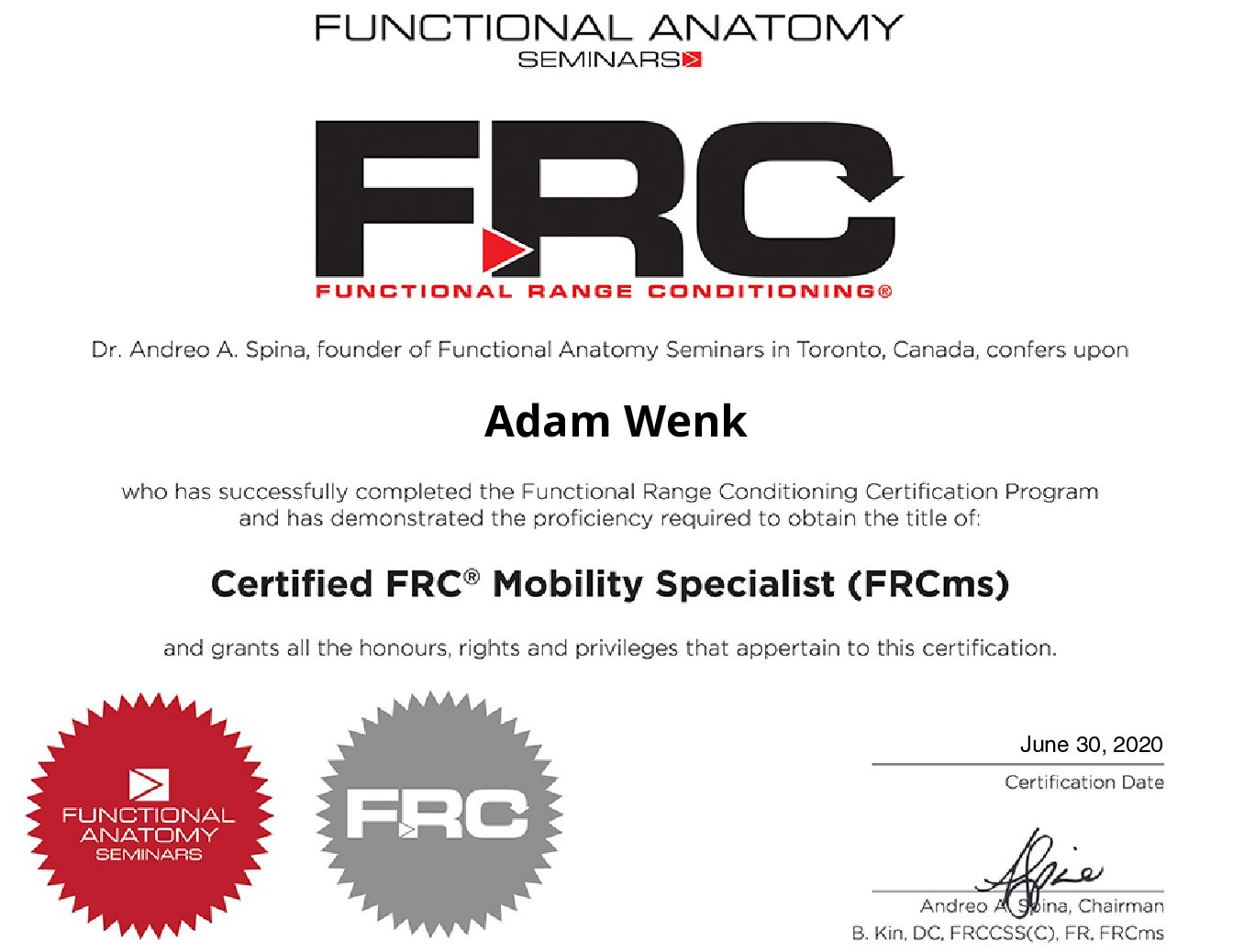
    Congrats to Adam for earning his Functional Range Conditioning certification—proud to have you on the PTS team! #mobility #jointhealth #education #resultsdriven

  • Meet our featured partner, Leah Schmitt PT, DPT CFMT

    Meet our featured partner, Leah Schmitt PT, DPT CFMT

    Leah Schmitt is a Physical Therapist certified in Functional Manual Therapy and the president of Leah Schmitt Physical Therapy. Her practice emphasizes in hands on body work to achieve ultimate efficient functioning and to address pain and dysfunction. Leah is also certified in Functional Dry Needling and Pelvic floor therapy. She treats everything from neck and back pain, joint pain, migraines, foot/ankle issues, pelvic floor dysfunction or those who just want to perform better. Give her a call today to schedule at 312-278-7771!


  • Yes, Mobility Is That Important

    Yes, Mobility Is That Important

    By: Bobby DeThomasis

    Everyone knows that stretching is important (at least for most people, but not necessarily for all), however I still think that not nearly enough emphasis is put on it and when mobility exercises are performed they are often done incorrectly.  In all honesty I am probably one of the worst culprits of mismanaging and under emphasizing my mobility training.  For a long time I was under the mindset that since I only have about 75 minutes per day (if that) to take care of my body I would rather go through a quick dynamic warm up, some quick self stretches and get straight into my workout.  Admittedly it actually took me a long time to even get to the point where I would devote even 15 minutes per day to my dynamic warm up.  For a long time my warm up would consist of doing one set of an exercise with 50% of my RM on the bar and I would start to train.  I would find though that it always seemed like I was spinning my wheels with my training.  I would train hard for a couple months and all the sudden my recurring back issue would flair up (as it often does as soon as I start to squat or deadlift heavy) and I would have to regress my training to doing unilateral work and rehabilitation.  I would start to stretch more and my back would start feeling better at which point I would start squatting again and just perpetuate the same cycle.

    This went on for quite some time (more then I would like to admit) and although deep down I knew what I had to do (devote more time toward proper mobility training) I kept falling into the same cycle of back pain from heavy squatting,  stretch, feel better, squat heavy, re-injure and start stretching again.  As much as it pains me to say it, I am now a full believer in that sometimes you need to take a step back, re-evaluate what you are trying to accomplish and develop a proper course of action.  A course of action that may be hard to accept initially because let’s face it, for people who see working out as a huge part of their lives it is difficult to say “I am going to spend less time working out and more time stretching.”  Not to mention, anyone who has poor mobility would agree that stretching is basically the worst thing ever.  It is uncomfortable, tedious, boring and so slow to improve.  I am here to insure you that in this case the juice is definitely worth the squeeze and if you are someone like me who seems to always be spinning their wheels with their training and constantly getting set back with injuries, a proper mobility program may just be the answer.

    OK, so now that we agree that mobility is important, what is the best way to design a proper mobility program?  First off, you have to find out where you have restrictions. The best way to determine flexibility issues would be to get evaluated by someone who has an in-depth understanding of a movement analysis system that could provide the necessary information.  Since the details of how to perform a proper movement analysis are outside the scope of this article I would suggest finding typical symptom patterns associated with your daily life activities.  For instance, it is very typical for a hockey player to develop restriction though their hip flexors, hip rotators, quads, pectoralis minors and shoulder internal rotators.  A person that sits behind a desk all day coincidently will develop similar restriction patterns in that they typically get very tight through their shoulder internal rotators (subscapularis, and teres major) pectorals minor and subclavius in the upper body.  Hip flexor complex (rectus femoris, psoas, iliacus and tensor fascia latae) and hip rotators in the lower body.  I have also found that many people (athletes especially) test positive for ankle restriction going into dorsiflexion.  This lack of dorsiflexion could have significant implications on a persons ability to squat, deadlift, olympic lift and play many sports while staying healthy.  Some experts have estimated that the single best indicator for lower body injury potential is to measure a persons ankle dorsiflexion.  If you are a person that is blessed with good ankle dorsiflexion then congratulations, everything is going to be easier for you.  For the rest of us poor souls we had better focus a good amount of time on improving ankle dorsiflexion.  There are plenty of good videos online that can show stretches for dorsiflexion.  I would highly recommend implementing some of those stretches into your daily routine.  I should  note however that unfortunately for some people improving dorsiflexion is not always as easy as just stretching.  If you are the type of person that gets a pinching sensation in the front part of the ankle when you go into dorsiflexion (as opposed to feeling a stretch in the achilles tendon area) then you most likely have an ankle impingement.  Ankle impingements are difficult to treat on your own and I would recommend seeing a qualified coach/therapist for proper guidance.

    This article is meant to emphasize the importance of proper flexibility and mobility.  As I mentioned earlier, everyone is different.  One person may have significant restrictions through their quadriceps where as another may be more restricted through the hamstrings.  The best way to understand where your restrictions lie is through an in-depth movement analysis by a knowledgable coach/therapist. If you would like more information on how a structured flexibility program could help improve your sports performance and decrease your susceptibility to injury email us at info@performancetrainingsystems.com and you can set up an appointment for an in-depth evaluation.