

Tag: Training
-

Why You Should Track Performance While Training
Do you want to make sure you are making progress in the gym from week to week? Tracking your performance is one of the most important factors regarding our previous article: “How to Train for Muscle Growth” where we discussed the proper implementation of progressive overload.
For a quick recap, progressive overload refers to us progressing the difficulty of our training from one week to the next to continue to challenge our bodies. Without a continuous increase in difficulty, there is no need for our bodies to adapt any further. This increase in difficulty can come in many forms, from increasing the weight, to reducing rest periods, to changing our repetition range, the list goes on. The bottom line is that if we do not continue to challenge ourselves, we will not continue to make progress.
With progressive overload in mind, we want to make sure we are not pushing ourselves too hard from week to week. Pushing too hard can cause us to become overtrained and unable to recover before the next time we train that muscle group. You could actually be continuing to make strength improvements when overtrained but are unable to increase weight room performance week to week because our fatigue is masking our progress.
Being overtrained also puts us at a significantly higher risk for injuries while training. When the muscles we are trying to train are fatigued, we begin to incorporate other muscles into our movements in what we call “compensation patterns”. For example, if our legs are overtrained heading into a leg day and we start with deadlifts; due to fatigue, our legs will be unable to produce the same force they were last week so when we try to lift the same weight, we could be using more of our low back muscles than usual which increases our risk for back injuries.
The two most important aspects of this article are that we need to increase the difficulty of our training from week to week and we need to make sure we are not overtraining ourselves. The implementation of these two aspects becomes significantly easier when we begin recording the performance of our training.
Without recording our performance, it can be very difficult to remember what we did each set the previous week. If we can’t remember what we did the week before, we could choose a difficulty that is either too hard (which makes us overtrained) or too easy (where we could make more progress). Recording our performance eliminates any guess work and will keep us increasing the difficulty and getting stronger week to week.
Of the many ways you can track your progress, we recommend using an app like “GymBook” or using the old-fashioned method of writing it into a notebook or the notes app on your phone. You can’t go wrong with the notes app or a notebook, but apps like “GymBook” are great because they automatically chart your performance of each set on a line graph so you can see an accurate visualization of your progress.
Here at PTS, all of our Strength and Conditioning Coaches track your performance of every rep of every set, in order to ensure that we are safely and effectively implementing progressive overload to your training.
Give us a call (312-666-7147) or send us an email (info@performancetrainingsystems.com) and one of our many qualified professionals will be able to discuss any questions you may have.
-
How to Begin a Fat Loss Diet
Have you ever set out on a fitness journey with one of your friends only to find that they are making more progress than you when you’re both doing the same thing? In this article we will discuss how your diet plan should be specifically tailored to you and your individual goals – and how your strategies may differ from that of others.
At this point in time it is common knowledge that in order to lose body fat we need to be consuming less energy (food) than we are using throughout the day for daily activities (brushing your teeth, walking to your parked car, exercising, etc…). When this happens, we begin to use the energy we have stored in our bodies (body fat). This line of thinking could then lead us to believe that more is better, and that the fewer calories we take in, the more fat we will lose. This is true only in regards to short-term (1-2 weeks) fat loss but will not provide us with the desired results long term and can have adverse health effects in regards to our quality of life. This will be discussed further in the following article.
It is easy to find an estimate of how many calories we should eat in a day to maintain our current body weight but since these numbers are only estimates it will take some guess and check work initially to get dialed in. The first step in this process is to find our basal metabolic rate (BMR) which is our energy expenditure estimate for a day. There are many online calculators you can use but we can also use the Harris Benedict Equation that these calculators are derived from:
Men: BMR = 13.397W + 4.799H – 5.677A + 88.362
Women: BMR = 9.247W + 3.098H – 4.330A + 447.593
Where W = weight in kg, H = height in cm, and A = age in yearsFor example, a 180lb, 5’11, 27 year old male would burn roughly 1,814 calories throughout the day without physical activity. To add physical activity into our daily energy expenditure, we will multiply this number (1,814) by our “activity factor”. If I were a sedentary individual (little or no exercise) I would multiply this number by 1.2, meaning I burn 2,176 calories throughout the day living a “sedentary lifestyle”. This multiplication changes as your activity level increases and is as follows:
– Sedentary
– x1.2 = 2,176 calories/day
– Lightly active (light exercise/sports 2-3 days/week)
– x1.375 = 2,494 calories/day
– Moderately active (exercise/sports 3-5 days/week)
– X1.55 = 2,811 calories/day
– Very Active (hard exercise/sports 6-7 days/week)
– x1.725 = 3,174 calories/ day
– Extra Active (Physically demanding manual labor jobs, i.e. construction or landscaping work)
– x1.9 = 3,446 calories/ dayOnce we have our BMR, we can then aim to eat less calories than our given number to lose weight. We can also utilize the information regarding protein intake discussed in the “How to Prevent the Age Related Loss of Muscle Mass (Sarcopenia)” and “Differences in Losing Body Weight With and Without Exercise” articles posted on our website to help us keep our muscle mass throughout this process. Once our protein requirements have been met and we are ensuring optimal fat intake, we can then fill in the rest of our calories with carbohydrates. We should aim to eat no fewer than 500 calories less than our BMR as this will help us preserve muscle mass and lose body fat in a way that will not cause adverse health effects.
Stay tuned for the next article where we will discuss various strategies we can implement to ensure that the weight we are losing is fat and not muscle in a safe and effective way. If you are someone looking to begin their fitness journey and are unsure where to start, give us a call as we have many qualified professionals eager to help you take the first step!
References:
– Wilkinson, 2016
– Helms, 2022
– Antonio, 2018 -
Differences in Losing Body Weight With and Without Resistance Exercise
The most important aspect of any diet put into place with the goal of losing body fat is that we need to ensure we are implementing a “calorie deficit”. The term “calorie” or “caloric deficit” refers to the energy balance in our bodies throughout everyday life – being in a caloric deficit just means we are eating less calories than we are burning, so our bodies begin using other energy stores in our body (body fat, muscle glycogen, muscle proteins) to provide us with energy for daily living. While a caloric deficit is the primary determining factor in regards to weight loss, the macronutrient composition of our diet along with our daily physical activity will determine what body composition changes occur – that is, if we are losing fat or muscle.
The three primary macronutrients we mostly refer to are carbohydrates, fats, and proteins. For those who aim to lose body fat, it is imperative that we provide our body with what it needs to provide us with the desired body composition changes – i.e. losing body fat, not muscle. The goal of any fat loss program should be to improve physical health, regardless of body composition goals. A caloric deficit alone is not sufficient to elicit significant fat loss changes in a healthy way because when our bodies are receiving less energy than we are burning, we will begin to use energy from stores around your body (muscle protein, glycogen, and body fat). Losing muscle protein would result in a loss of strength and thus, we would be losing weight in an unhealthy way, whereas losing body weight primarily through the loss of body fat would result in us retaining as much strength as possible. The easiest way to lose body fat while retaining muscle mass and strength is to engage in frequent resistance training while eating sufficient protein.
When engaging in frequent resistance training (2-6 times per week) our bodies will adapt to that stress by improving our strength through muscle size and force production but these improvements are primarily determined by the amount of protein we eat every day before and after we train. When resistance training, each rep of each set we are breaking down the force producing components of our muscle (this is one of the reasons we have better “performance” in terms of force production at the start of a workout compared to the end – by the end, more parts of the muscle are damaged and can no longer produce the same force). When we eat protein, our bodies use this digested protein in the form of amino acids to repair the damaged parts of our muscle from resistance training. For this reason, to lose body fat and avoid muscle loss, it is imperative that we ensure we are eating more protein during the day (~0.8g -1.5g protein per lb of body mass [150lb person would need 120 -225g of protein each day]) than we are breaking down during our training and everyday activities. Once we ensure we are training hard enough to retain our strength and eating enough protein to repair our muscles, it is reasonable for us to believe we should be able to retain all of our strength during a fat loss phase if not even gain strength throughout the process.
If you are looking to lose body fat and improve body composition, one of PTS’s coaches can help. Our coaches are experts at losing weight the healthy way to make sure you are getting lean and staying strong. Give us a call to find out more information as to how you can get on an individualized program.
-
Off-Season Hockey Training
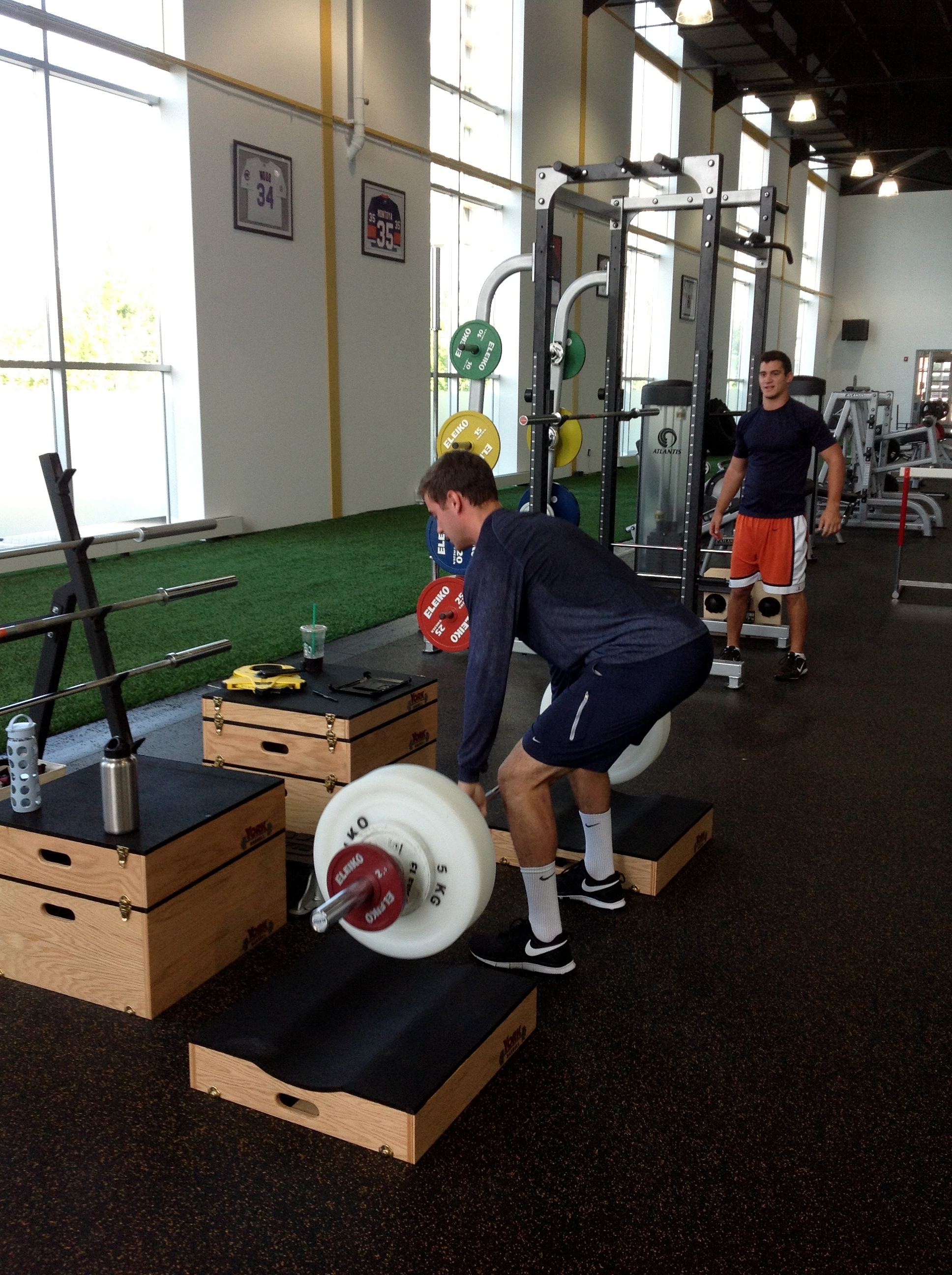
Here is a video of some of our hockey players working hard during the off-season.