
Click Here For The Video
Author: Jessie DeThomasis
-
A Scientific Approach To Losing Body Fat
In this installment I would like to discuss the common misconceptions surrounding body composition improvement and the fallacy that is calorie counting.
Despite the popularization of the “low calorie” approach to weight loss which has been at the fore front of nutrition mass media over the past several decades, scientific research has proven that approaching weight loss and body composition improvement is much more in depth than the calorie in-calorie out theory. What first must be realized is that not all calories are created equal. To get more in depth we will have to dive into the world of macronutrients.
The three categories of macronutrients are protein, fat and carbohydrates. Each of these categories has its own caloric value in that every gram of protein and carbohydrate contains four calories each and every gram of fat contains nine calories. It would stand to reason that if you were following a low calorie diet you should limit the amount of fat that you consume and since fat grams contain nine calories each your overall caloric load would decrease. Although this may be true, what you need to realize is that every single cell in your body (whether it is a muscle cell, vascular cell, neurological cell etc.) has a membrane that is made up of certain essential fatty acids and if you begin to decrease the amount of fat that you are taking in, your body will have a very difficult time maintaining cell membrane integrity. In turn this could have a negative effect on losing body fat because you will decrease your ability to get essential nutrients into cells where they can be used as energy. This may cause your body to respond by storing more of that energy (usually in the form of blood glucose) in adipose tissue or body fat.
What many people fail to realize is that there is an entirely other system in the body that plays a major role in the way you either use stored body fat for energy or store the foods that you are eating into more body fat. The system that I am speaking of is your endocrine or hormonal system. Every time you eat something your digestive tract will break it down into its most simplistic form then transfer the nutrients from that food into the blood stream. Depending on the macronutrient profile of the foods that you consume the digestion process can either be very fast or much slower. The faster you digest a food, the faster its nutrients can get into the blood stream which in turn will raise your blood sugar levels. Once sugar gets into the blood in the form of glucose (the simplest form of sugar) your pancreas will release insulin, also known as the “storage hormone”, to take that glucose and put it into storage somewhere. Your body would like to put most of that glucose into its muscle cells (where it will be stored as glycogen and eventually used as energy) but after muscle cells become completely saturated, which can happen very easily, your body must find somewhere else to store that sugar. It will then put a small amount in your liver to be stored as glycogen and then finally start storing a large majority of the glucose in your fat cells increasing body fat storage.
Your best bet to stay out of a state of elevated blood sugar and subsequently constantly high insulin production is to eat foods that have a slow digestive rate or low glycemic index (minimally impacts blood sugar). Carbohydrates have the fastest digestive rates and therefore produce the largest increase in blood sugar levels. If your goal is to decrease overall body fat and improve body composition then you would be wise to try and limit your intake of fast digesting/high glycemic carbohydrate based foods. Instead get the majority of your calories from good protein sources (organic meats and wild caught fish) and healthy dietary fat (omega 3 fatty acids) in order to maintain stable blood sugar levels throughout the day and keep your body from producing excess amounts of insulin. In addition to the intake of high quality proteins and fats it is also very important to eat a wide variety of vegetables. Vegetables contain high amounts of vitamins, minerals, phytonutrients and fiber. All of these nutrients are vital to overall health and well being and they play a major role in the overall improvement of body composition.Now I know what you are thinking, “don’t I need those carbohydrates for energy?” Actually the answer is NO! If your body does need to synthesize carbohydrates for glycogen storage or immediate energy you actually have the ability to take a molecule of protein and/or fat and put it through a process called gluconeogenesis in the liver that basically converts it into a carbohydrate. It typically takes about two weeks for your body to realize the decrease in carbohydrate consumption and then it will start utilizing stored body fat for energy.
For more information on how improving the function of your endocrine system can aid in a much more effective and long lasting improvement in body composition contact PTS to learn about our nutrition consultation packages at performancetrainingsystems.com.
By: Bobby DeThomasis
-

Order MCT Lean Products on our Website!
Order pharmaceutical grade MCT oil and great tasting vegan protein through our new partner MCT Lean. MCT Lean is a local company that manufactures great quality protein and MCT oil to keep you fueled and recover from your training. To order their products click here
-
Improving Speed and Explosiveness for Power Sports
With the exception of the sport of power lifting, where the goal is to lift as much load as possible, regardless of the time it takes, an athlete’s performance in most other sports is determined by speed, power and explosiveness. In sports such as football, hockey, basketball, track and field, etc. it is not enough to just be strong. Athletes need to be able to produce high levels of force in a very short period of time. In his book, ‘Supertraining,’ Dr. Yuri Verkhoshansky refers to this as the “Rate of Force Development” (RFD) or “Rate of Tension Development” (RTD).
When training for any sport where speed and explosiveness are important, which as I previously mentioned is just about every sport, the end goal should always be an improvement in the rate at which an athlete can develop force or an increase in the RFD. This sounds easier then it actually is. This improvement in RFD can only be achieved through the proper periodization of both strength and speed phases through an off season training regimen. This article will give an in-depth look at how to appropriately periodize an off season training regimen to improve speed, power and RFD.
As many people know, if you want to increase RFD you must be doing plyometrics, right? The truth is that although plyometrics can play an important role in athletic development, if those exercises are not performed properly and during the correct phase, they may have a detrimental effect on an athlete and their performance. Starting at a young age, athletes are performing extremely high volumes of plyometric exercises often with out even knowing it. For instance, one of the most ‘plyometric’ exercises an athlete can perform is sprinting (as measured by the amount of force it places on the body). Since many sports that young athletes play (i.e. soccer and basketball) consist of a high volume of sprinting, their bodies start adapting to the effects of plyometric exercises at a very early age. Due to the fact that many sports have such a high volume of sprinting and jumping exercises (i.e. volleyball) it would seem logical that adding more jumping into the strength and conditioning program would be counterproductive, especially for a young athlete that has not yet built the strength through his/her soft tissue system (muscles and connective tissue) to withstand the force of plyometrics. Too commonly strength and conditioning coaches, personal trainers and sport specific coaches prescribe jumping exercises to young athletes in an effort to increase power however if the volume reaches a higher level than the individual can withstand the athlete can start to develop overuse injuries such as patella tentonitis (jumpers knee), achillies tendonitis, or a host of other issues. Coaches must keep in mind that power is defined as Force x Velocity (P=FxV). An appropriate training program would dictate that an improvement in power will not only come from plyometric training to increase velocity, but also through the improvement in the athlete’s ability to develop force (aka strength).
In his book, ‘Periodization Training For Sport’, Tudor O. Bompa states “For speed sports, power represents a great source of speed improvement. A fast sprinter is also strong. High acceleration, fast limb movement and high frequency are possible when strong muscles contract quickly and powerfully.” He then goes on to describe how improvement in a muscle’s, or group of muscles’, ability to produce force will have a direct improvement in power development. Strength is the basis for all biomotor abilities (i.e. speed, power, explosiveness, endurance, etc.). Without an increase in strength, an athlete will only have the ability to develop so much power and speed before they hit their ceiling. Through the proper implementation of strength training regimens and appropriate off season periodization a coach should focus on increasing their athlete’s strength first and foremost. Once an improvement in maximal strength is achieved, the athlete then has a platform to transfer their gained strength into more fast contracting movements through the implementation of plyometric exercises. As an athlete progresses closer to their competition season it would be prudent of the coach to add in ballistic movements such as jumping, bounding and sprinting to help improve the athlete’s RFD. However prior to the ‘transformation phase’ the main goal of the coach and the athlete should be an increase in maximal strength. Bottom line, just get strong!
By: Bobby DeThomasis
For more information as to how you can increase your strength, speed, power and rate of force development email us at info@performancetrainingsystems.com to speak with an expert coach.
-

Order your DFH supplements online!
Forgot to pick up your fish oil before you go out of town for a few weeks? Don’t worry, now you can order all of the Designs For Health professional grade products from our website.
Please use practitioner code: JESSIEDETHOMASIS when you sign up for your account using the link below.https://checkout.netsuite.com/s.nl/c.ACCT14095/n.1/sc.2/.f?login=T&reset=T&newcust=T&noopt=T&partner=
-

Join us for a Brandon Marshall Fundraising Event!
Performance Training Systems and Chicago Chiropractic & Sports Medicine are excited to host the event benefiting The Brandon Marshall Foundation, which is a nonprofit organization dedicated to spreading the word about mental health and advocating for treatment and support to benefit the millions suffering from mental illness. The event will be held on Thursday, June 5th from 7pm-9pm and 100% of the proceeds will be donated to The Brandon Marshall Foundation.
Tickets are $10 and include:
– 1 Raffle Ticket for amazing give-aways (signed memorabilia, personal training sessions, massages, wine tours and more!)
– Cocktails by Bartend Chicago
– Food from Tete Charcuterie, The Salsa Truck & Protein BarBring your friends and enjoy a night out to benefit a great cause and kickoff the summer! Register here.
-

CHECK US OUT IN CRAIN’S
This is a recent article in Chicago’s premiere business publication, Crain’s. The article focuses on the workout of one of our client’s, Dan Hyman. Click the link below to check out the video….
-
Off-Season Hockey Training
Here is a video of some of our hockey players working hard during the off-season.
-
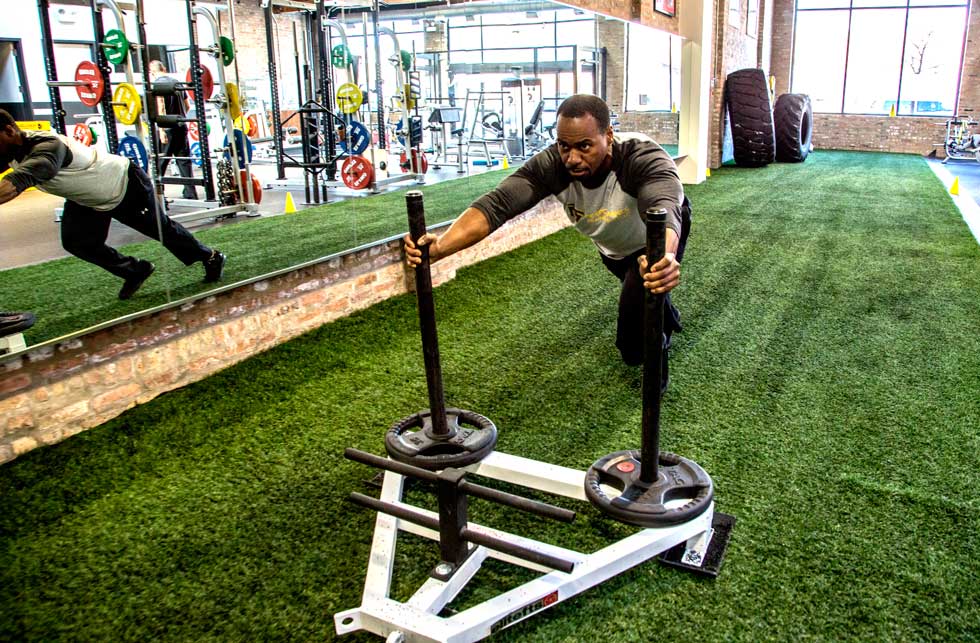
Applied Strongman Training
“Strongman Training” is not a new form of exercise. In fact, quite the opposite is true. If you trace strength and conditioning back to its inception you might find that lifting, pushing, pulling and walking with heavy objects has always been a part of physical conditioning. At PTS we use many different implements that mimic some of the movements currently known as “Strongman Training.” In this article, we will discuss three different types of Strongman exercises and their benefits.
Sleds/Prowler
The sled and prowler are probably the most commonly recognized pieces of Strongman Training equipment. This is likely due to their versatility. The benefits of the sled are far reaching and when applied appropriately can be used for everything from injury rehabilitation and structural balance to athletic development and body composition improvement. Moving the sled is a very low impact movement that does not create a high level of shear force on a person’s joints. It can therefore be used to increase strength in the lower body musculature without running the risk of further damaging injured joints. Moreover, while doing sled training a person only has the ability to move the sled using what physiologists call a concentric muscle action. This type of muscle action produces the least amount of muscle damage, as compared to eccentric and isometric contractions, and as such will decrease the potential to delayed onset muscle soreness.
Another benefit to sled training is that when applied with the appropriate loading parameters it can cause a significant increase in the production of lactic acid from the working muscles. That increase in lactic acid has been proven to have a positive impact on body composition. When applied correctly sled training has been proven to be one of the most effective tools for dropping body fat!
From an athletic standpoint, the main function of sled training is based upon the development of sport specific energy systems. Energy systems are the ways your body uses fuel to produce work. Depending on the duration and the intensity of activity, the energy system used can change from the anaerobic alactic power system (commonly used in explosive sports like the 100m dash) to the anaerobic lactic systems and even the aerobic capacity system. When we train an athlete, we will mimic the energy system that is used in their respective sport using the sleds. For instance, if we are training a hockey player that has an ‘on ice’ shift of about 45 seconds and then has 2 minutes before they go out for another ‘on ice’ shift, we would have the athlete push the sled for 45 seconds and then rest for 2 minutes before pushing it for another 45 seconds. We would typically have the athlete repeat that cycle 4-6 times (the typical amount of shifts a hockey player goes through in a period) and have the athlete complete 3 total ‘periods’ of 4-6 shifts with about 6 minutes rest in between each ‘period.’ This helps improve the athlete’s work capacity within the given energy system (a complete hockey game for example) that is dominant in their sport. This training gives them the ability to produce a great amount of force in an efficient manor for a longer period of time.
Large Tires
PTS has two tires, one that weighs 300lbs and the other is about 800lbs. We have two primary exercises that we use the tires for, tire flips and tire fights. The tire flip is performed exactly as it sounds. While the tire is lying flat on the ground the athlete squats down and places their hands under the tire’s treads. The athlete then proceeds to lift one side off the ground and push it over onto the other side. This movement is a very effective way to transfer strength that has been gained with traditional strength exercises like squats, deadlifts and chest presses into more functional strength.
We use tire fights with our athletes that need to be able to resist force from an opponent. For this exercise, we will have two athletes working at once, each standing on opposite sides of the tire, facing one another. Each athlete has their hands on the tire throughout the entire set and the purpose is for each athlete to try and push the tire over on the other and mimic battling their opponents on the field with various movements and motor patterns.
Farmer’s Carry
The Farmer’s Carry is composed of two cambered bars that have Olympic size weight sleeves on either side. The exercise is to walk while holding onto both bars for a pre-designated distance. This exercise has been proven to improve grip strength, ankle stability, low back strength, quadratus lumborum strength and coordination as well as overall work capacity. We use this exercise with many of our athletes, but it is particularly effective at improving performance in sports that require a strong grip while performing other tasks, such as in wrestling, martial arts and other grappling sports.
This article just touches on the many functions of Strongman Training. For a creative strength coach/trainee the possibilities of exercise variability are endless. For more information on Strongman Training and how it can help you reach your fitness and athletic goals contact a PTS strength coach.