Category: Training

  • Using Science To Improve Sport Specific Conditioning

    Using Science To Improve Sport Specific Conditioning

    I often get asked the question “what type of conditioning do you do with your athletes?” and my answer is always the same……”it depends on the sport, position and individual.”  No two sports are exactly alike and no two positions in a given sport are exactly alike either.  This article will give a brief overview of the different physiological energy systems and how each one is impacted by activity, exercise and sports.

    To begin, it would be worthwhile to clearly define what energy is and the different types of systems that the body utilizes to produce and maintain energy.  The body maintains a continuous energy supply through the use of adenosine triphosphate or ATP.  You all may remember ATP from high school biology as the special carrier for free energy.  Ultimately the food that you eat will go through many processes to eventually produce ATP.  When your talking about producing energy for work (albeit for normal daily activities like grocery shopping or sporting events like sprinting a 100 meter dash) your body has three methods of producing that energy.  The three methods are known as the phosphagen system, glycolosis and the aerobic system.  Depending on the intensity and duration of your sport/activity you may use one, two or all three of these systems.

    The phosphogen system (aka ATP-CP system) is the primary energy system that is used in bouts of physical work under about 10 seconds (depending on the individual the phosphogen system may be slightly shorter or longer than 10 sec).  In this systems you muscle basically uses its stored ATP for energy.  A working muscle can re-synthesize ATP from creatine phosphate or CP and between the two (stored ATP and re-synthesized ATP from CP) you can produce physical work for about 10 seconds.  After that, your body needs to start producing energy through the breakdown of carbohydrates by the process of glycolosis.

    Glycolosis is the primary systems that produces ATP between 10 seconds and 2 minutes of work.  Carbohydrates in the form of either blood glucose or stored muscle glycogen are broken down in the muscle cell through a series of chemical reactions that ultimately form pyruvate.  Through this process two ATP will be produced.  If the production of pyruvate is greater then the supply of oxygen then the pyruvate gets converted to lactate (which will drop the PH level in your muscles and give that all too familiar burning feeling).  Neither the phosphogen system or glycolosis are oxygen dependent meaning they do not need oxygen to produce energy.  Therefore they are both considered anaerobic energy systems.

    The aerobic energy system is basically used to produce energy after 2 minutes of work.  This is the primary energy systems used in longer endurance events like 5K races, triathlons and other endurance events.  During this process a molecule of either glucose, glycogen or fat gets transported into the cell’s mitochondria and goes through several processes to ultimately produce high levels of ATP (36 for glucose and glycogen and up to 129 for fat).

    OK, so what does all this mean?  Well, depending on your sport’s energy demands you may need to emphasize the development of one or more of the these energy systems.  Common misconceptions amongst coaches is to have hockey players ride a stationary bike for 45-60 minutes claiming that it improves aerobic capacity.  Although that may be true, hockey shifts typically last no longer then 45 seconds.  So by the rules of physiology you are not even coming close to using the aerobic system for the production of energy.  In large part most of a hockey player’s energy is produced through the phosphogen and glycolitic systems.  Therefore it would be unwise to have a hockey player perform long duration/low intensity training training when the demands of his/her sport are obviously much different.  When designing a strength and conditioning program for any sport you should look at the energy demands of that sport and try to mimic your ‘conditioning’ program around those energy systems.  For instance, since a typical shift in hockey is 45 seconds and there is about 2 minutes in between shifts, you may want to have your hockey players push a sled at a high intensity for 45 seconds then rest for 2 minutes and repeat 3-4 times (depending on the line that a player is on he or she may be on the ice for 4-5 shifts per period.  You may then want to give the athlete about 8-10 minutes off depending on the level of hockey that they play, pick another exercise and repeat the process 2 more times (since there are 3 periods in a hockey game).

    This principle of ‘sport specific’ energy systems development can be applied to athletes from all disciplines.  The main characteristics of a good conditioning program is to analyze the energy demands of the sport (i.e. work:rest ratio) and mimic them as close as possible in the weight room.

    At PTS, our coaches are skilled at analyzing the energy demands of all sports and appropriately designing training programs around each athlete’s needs.  For more information on how specific energy system training could improve your athletic performance email us at info@performancetrainingsystems.com and set up an evaluation with one of our coaches.

    By: Bobby DeThomasis
  • Improving Speed and Explosiveness for Power Sports

    Improving Speed and Explosiveness for Power Sports

    With the exception of the sport of power lifting, where the goal is to lift as much load as possible, regardless of the time it takes, an athlete’s performance in most other sports is determined by speed, power and explosiveness.  In sports such as football, hockey, basketball, track and field, etc. it is not enough to just be strong.  Athletes need to be able to produce high levels of force in a very short period of time.  In his book, ‘Supertraining,’ Dr. Yuri Verkhoshansky refers to this as the “Rate of Force Development” (RFD) or “Rate of Tension Development” (RTD).

    When training for any sport where speed and explosiveness are important, which as I previously mentioned is just about every sport, the end goal should always be an improvement in the rate at which an athlete can develop force or an increase in the RFD.  This sounds easier then it actually is.  This improvement in RFD can only be achieved through the proper periodization of both strength and speed phases through an off season training regimen.  This article will give an in-depth look at how to appropriately periodize an off season training regimen to improve speed, power and RFD.

    As many people know, if you want to increase RFD you must be doing plyometrics, right? The truth is that although plyometrics can play an important role in athletic development, if those exercises are not performed properly and during the correct phase, they may have a detrimental effect on an athlete and their performance.  Starting at a young age, athletes are performing extremely high volumes of plyometric exercises often with out even knowing it.  For instance, one of the most ‘plyometric’ exercises an athlete can perform is sprinting (as measured by the amount of force it places on the body). Since many sports that young athletes play (i.e. soccer and basketball) consist of a high volume of sprinting, their bodies start adapting to the effects of plyometric exercises at a very early age.  Due to the fact that many sports have such a high volume of sprinting and jumping exercises (i.e. volleyball) it would seem logical that adding more jumping into the strength and conditioning program would be counterproductive, especially for a young athlete that has not yet built the strength through his/her soft tissue system (muscles and connective tissue) to withstand the force of plyometrics. Too commonly strength and conditioning coaches, personal trainers and sport specific coaches prescribe jumping exercises to young athletes in an effort to increase power however if the volume reaches a higher level than the individual can withstand the athlete can start to develop overuse injuries such as  patella tentonitis (jumpers knee), achillies tendonitis, or a host of other issues.  Coaches must keep in mind that power is defined as Force x Velocity (P=FxV).  An appropriate training program would dictate that an improvement in power will not only come from plyometric training to increase velocity, but also through the improvement in the athlete’s ability to develop force (aka strength).

    In his book, ‘Periodization Training For Sport’, Tudor O. Bompa states “For speed sports, power represents a great source of speed improvement. A fast sprinter is also strong. High acceleration, fast limb movement and high frequency are possible when strong muscles contract quickly and powerfully.”  He then goes on to describe how improvement in a muscle’s, or group of muscles’, ability to produce force will have a direct improvement in power development.  Strength is the basis for all biomotor abilities (i.e. speed, power, explosiveness, endurance, etc.). Without an increase in strength, an athlete will only have the ability to develop so much power and speed before they hit their ceiling.  Through the proper implementation of strength training regimens and appropriate off season periodization a coach should focus on increasing their athlete’s strength first and foremost.  Once an improvement in maximal strength is achieved, the athlete then has a platform to transfer their gained strength into more fast contracting movements through the implementation of plyometric exercises.  As an athlete progresses closer to their competition season it would be prudent of the coach to add in ballistic movements such as jumping, bounding and sprinting to help improve the athlete’s RFD.  However prior to the ‘transformation phase’ the main goal of the coach and the athlete should be an increase in maximal strength.  Bottom line, just get strong!

    By: Bobby DeThomasis

    For more information as to how you can increase your strength, speed, power and rate of force development email us at info@performancetrainingsystems.com to speak with an expert coach.

  • Off-Season Hockey Training

    Off-Season Hockey Training

    Here is a video of some of our hockey players working hard during the off-season.


  • Applied Strongman Training

    Applied Strongman Training

    “Strongman Training” is not a new form of exercise. In fact, quite the opposite is true. If you trace strength and conditioning back to its inception you might find that lifting, pushing, pulling and walking with heavy objects has always been a part of physical conditioning. At PTS we use many different implements that mimic some of the movements currently known as “Strongman Training.” In this article, we will discuss three different types of Strongman exercises and their benefits.


    Sleds/Prowler

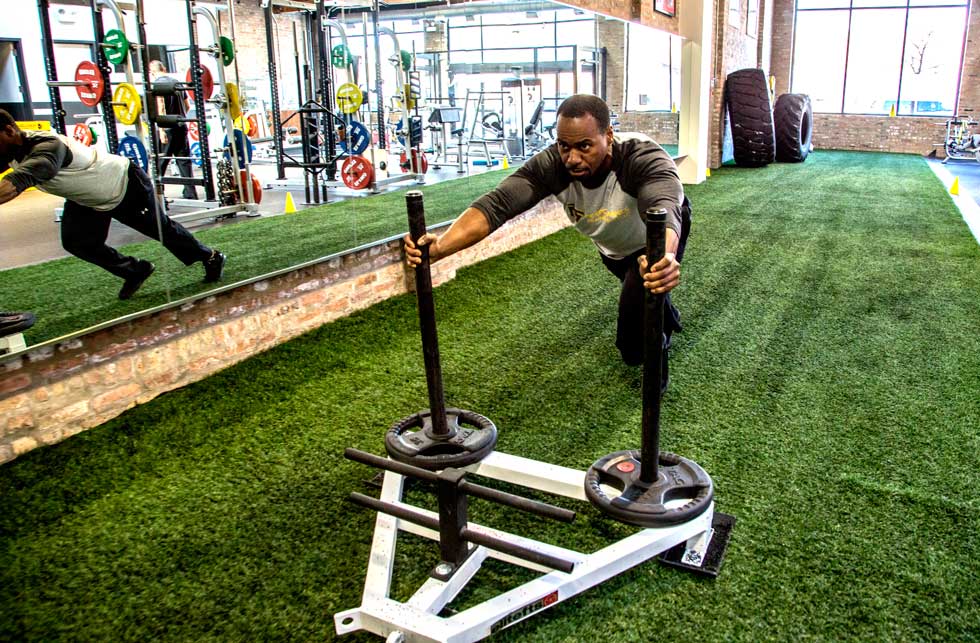
    The sled and prowler are probably the most commonly recognized pieces of Strongman Training equipment. This is likely due to their versatility. The benefits of the sled are far reaching and when applied appropriately can be used for everything from injury rehabilitation and structural balance to athletic development and body composition improvement. Moving the sled is a very low impact movement that does not create a high level of shear force on a person’s joints. It can therefore be used to increase strength in the lower body musculature without running the risk of further damaging injured joints. Moreover, while doing sled training a person only has the ability to move the sled using what physiologists call a concentric muscle action. This type of muscle action produces the least amount of muscle damage, as compared to eccentric and isometric contractions, and as such will decrease the potential to delayed onset muscle soreness.

    Another benefit to sled training is that when applied with the appropriate loading parameters it can cause a significant increase in the production of lactic acid from the working muscles. That increase in lactic acid has been proven to have a positive impact on body composition. When applied correctly sled training has been proven to be one of the most effective tools for dropping body fat!

    From an athletic standpoint, the main function of sled training is based upon the development of sport specific energy systems. Energy systems are the ways your body uses fuel to produce work. Depending on the duration and the intensity of activity, the energy system used can change from the anaerobic alactic power system (commonly used in explosive sports like the 100m dash) to the anaerobic lactic systems and even the aerobic capacity system. When we train an athlete, we will mimic the energy system that is used in their respective sport using the sleds. For instance, if we are training a hockey player that has an ‘on ice’ shift of about 45 seconds and then has 2 minutes before they go out for another ‘on ice’ shift, we would have the athlete push the sled for 45 seconds and then rest for 2 minutes before pushing it for another 45 seconds. We would typically have the athlete repeat that cycle 4-6 times (the typical amount of shifts a hockey player goes through in a period) and have the athlete complete 3 total ‘periods’ of 4-6 shifts with about 6 minutes rest in between each ‘period.’ This helps improve the athlete’s work capacity within the given energy system (a complete hockey game for example) that is dominant in their sport. This training gives them the ability to produce a great amount of force in an efficient manor for a longer period of time. 


    Large Tires

    PTS has two tires, one that weighs 300lbs and the other is about 800lbs. We have two primary exercises that we use the tires for, tire flips and tire fights. The tire flip is performed exactly as it sounds. While the tire is lying flat on the ground the athlete squats down and places their hands under the tire’s treads. The athlete then proceeds to lift one side off the ground and push it over onto the other side. This movement is a very effective way to transfer strength that has been gained with traditional strength exercises like squats, deadlifts and chest presses into more functional strength.

    We use tire fights with our athletes that need to be able to resist force from an opponent. For this exercise, we will have two athletes working at once, each standing on opposite sides of the tire, facing one another. Each athlete has their hands on the tire throughout the entire set and the purpose is for each athlete to try and push the tire over on the other and mimic battling their opponents on the field with various movements and motor patterns.


    Farmer’s Carry

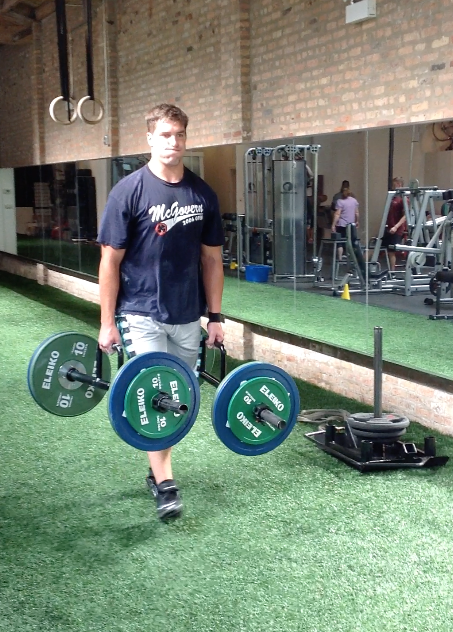
    The Farmer’s Carry is composed of two cambered bars that have Olympic size weight sleeves on either side. The exercise is to walk while holding onto both bars for a pre-designated distance. This exercise has been proven to improve grip strength, ankle stability, low back strength, quadratus lumborum strength and coordination as well as overall work capacity. We use this exercise with many of our athletes, but it is particularly effective at improving performance in sports that require a strong grip while performing other tasks, such as in wrestling, martial arts and other grappling sports.

    This article just touches on the many functions of Strongman Training. For a creative strength coach/trainee the possibilities of exercise variability are endless. For more information on Strongman Training and how it can help you reach your fitness and athletic goals contact a PTS strength coach.